

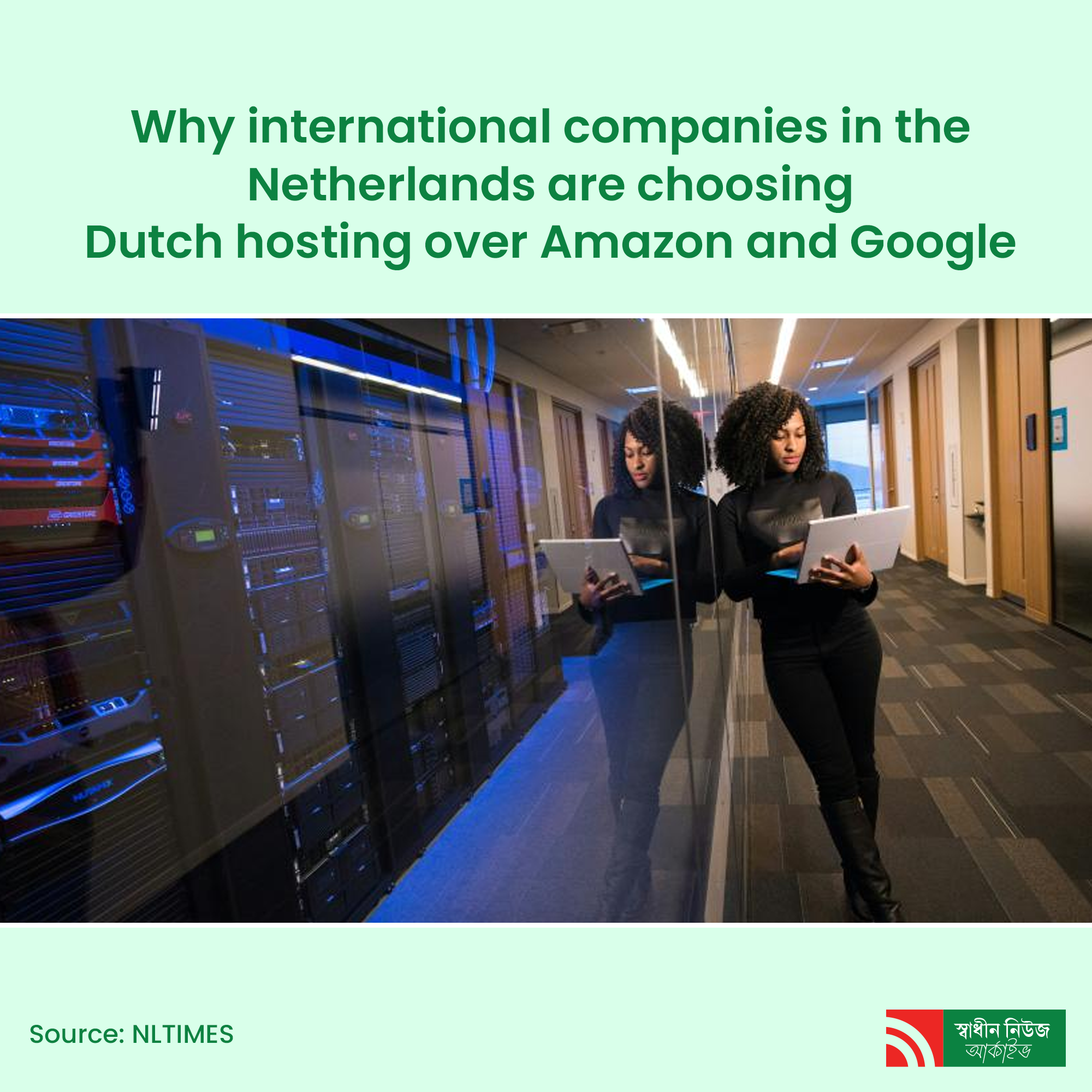
Why international companies in the Netherlands are choosing Dutch hosting over Amazon and Google
When a company incorporates in the Netherlands, data compliance questions follow quickly. EU registration means GDPR obligations apply from day one, and for many foreign businesses, that is the moment they realise their existing hosting setup in Virginia or Oregon may be creating legal exposure. Switching to a Dutch hosting provider is increasingly the answer, and the reasons go beyond a simple reading of the GDPR.
The Netherlands as a cloud infrastructure hub
The Netherlands sits at the centre of European internet infrastructure. The Amsterdam Internet Exchange (AMS-IX) is one of the busiest interconnection points in the world, and the country hosts a dense concentration of data centres serving continental Europe. For international companies setting up a Dutch entity, local hosting is not a step down in quality. The infrastructure is on par with anything a US hyperscaler offers, and in many cases physically closer to European end users.
The problem the GDPR alone does not solve
Hosting data on EU servers run by Amazon Web Services, Google Cloud, or Microsoft Azure addresses part of the GDPR requirement, but not all of it. Because these are US-incorporated companies, they remain subject to the US CLOUD Act, which allows American authorities to demand access to data regardless of where the servers are physically located.
The Dutch Data Protection Authority (Autoriteit Persoonsgegevens) has been explicit on this point: reliance on US cloud providers creates a jurisdictional gap that GDPR compliance alone cannot close. In January 2026, the authority warned that the Netherlands faces serious digital sovereignty risks from its dependence on a small number of foreign IT suppliers.
Choosing website hosting with a Dutch company incorporated under Dutch law, with servers on Dutch soil, removes that gap. Data processing agreements stay within EU jurisdiction from end to end.
Questions to ask any hosting provider
Not all providers who market themselves as GDPR-compliant are equally straightforward about what that means in practice. Before signing a contract, these questions are worth asking in writing:
- Where are the servers physically located, and can you guarantee data never leaves the EU?
- Is your company incorporated in the EU, or does it have a US parent or majority shareholder?
- Do you provide a Data Processing Agreement compliant with GDPR Article 28?
- Who has administrative access to the servers, and from which countries?
- What is your breach notification procedure and within what timeframe?
A provider unable to give clear, written answers to these questions is not a safe choice for handling EU personal data.
NIS2 adds further compliance obligations in 2026
GDPR is not the only regulation to plan around. The EU’s NIS2 Directive, which the Netherlands is transposing into national law, introduces security obligations across a broad range of sectors, including digital infrastructure providers and the organisations that use them. NIS2 requires companies to assess supply chain risks, and the hosting layer is part of that chain.
For companies in scope, hosting arrangements will be subject to scrutiny during audits. A Dutch provider with documented security measures, local legal accountability, and a clear chain of responsibility is considerably easier to audit than a multinational hyperscaler with support teams spread across multiple continents.
Antagonist is a Dutch hosting provider with servers located in the Netherlands and GDPR-compliant data processing agreements included as standard. For foreign businesses building a compliant EU presence, that kind of local accountability removes a significant layer of compliance uncertainty.